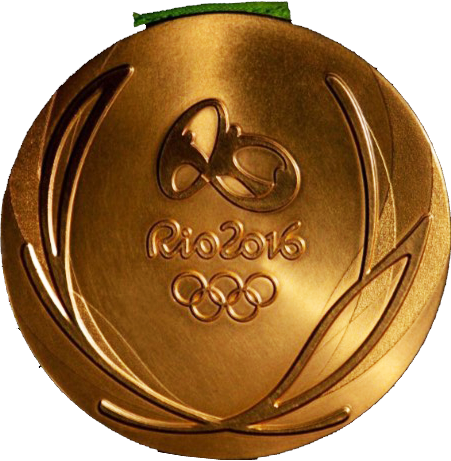
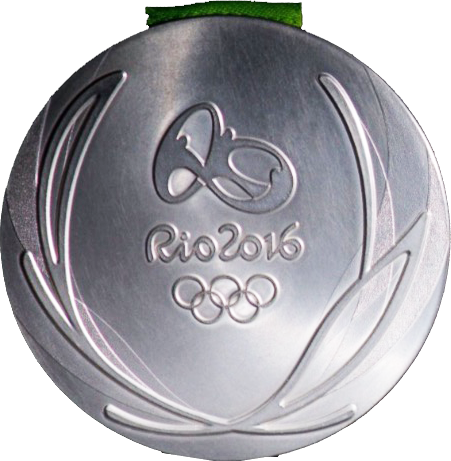
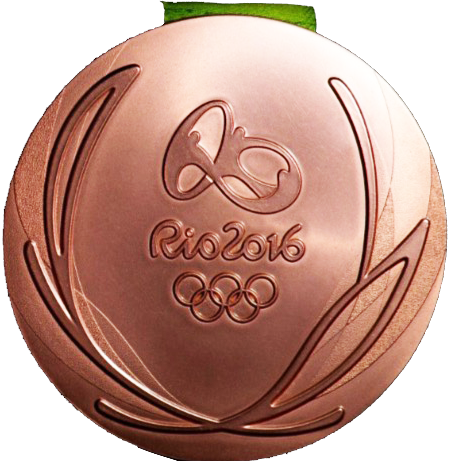

GOLD AND SILVER
Thursday, August 5th
By James O’Brien
Things will get busy today. That is certain. I apologize in advance. Here’s why:
- Will Claye and Joe Kovacs, both medal candidates – in the triple jump and shot put, respectively – are competing in their finals in the Olympic Stadium at the same time this morning.
- Erica Bougard, who, yesterday, ended her first day’s competition in the heptathlon in sixth position, resumes her medal challenge today (overlapping with Claye and Kovacs), in the long jump, javelin and 800m.
- In the early afternoon, the US women’s water polo team clashes with the Russian Olympic Committee in the semi-final of the tournament, the winner advancing to the final versus the winner of Spain versus Hungary.
- In the evening, back in the Olympic Stadium, while Erica Bougard is continuing her heptathlon campaign, Katie Nageotte will be contending for medals in the pole vault.
If all goes according to plan, today could be a day of singular note in NYAC Olympic history.
Let’s kick off with the shot put, which always promised to be a clash of titans. In Rio in 2016, the USA’s Ryan Crouser had taken the gold medal, one place ahead of our man Kovacs. But in 2019, at the World Championships in Doha, Qatar, the latter prevailed in a clash that shot put fans – and there are way more of them than you may surmise – are still talking about. Put it this way: one centimeter covered the first three places, with Kovacs on 22.91m, the USA’s Ryan Crouser on 22.90m and New Zealand’s Tom Walsh also on 22.90m. (In that instance, the second best throw is the decider). With no major championships in 2020, these Games were the first occasion on which these behemoths could renew that rivalry. Making things especially interesting was the fact that, on June 18th of this year at the US Olympic Trials, Crouser had erased one of the most revered world records on the books by recording a mark of 23.37m/76’ 8 1/4”. That, ladies and gentlemen, is a long way to throw 16lbs of ore. If nothing else, that was a line in the sand, a statement of intent for what was to go down in Tokyo. Events did not disappoint.
It was the quality of the competition rather than its ebb and flow that gave pause, and though the world’s finest went at it as hard as they could, it was Crouser who was the personification of athletic excellence. His first throw, a mammoth 22.83m/74’ 11” broke his own Olympic record by 31cms. Kovacs answered with a 22.19m/72’ 9 3/4” that installed him in the silver medal slot, and that was how the positions stayed. Crouser subsequently improved to 22.93m/75’ 2 3/4” on his second attempt, and to a monster 23.30m/76’ 5 1/2”- the second longest in history – on his last throw, and that with the gold already secured; but, the true mark of his dominance was that any one of five of his six throws would have been sufficient to win.
That is not to say that Kovacs – and Walsh – did not fight hard and to the finish. Indeed, the NYAC man is nothing if not a clutch performer and Crouser knew that he could not rest easy until his greatest rival had taken his last attempt. True to form, Kovacs launched a huge 22.60m/74’ 1 3/4”, but insufficient to topple the leader. In that, the placings from Rio were replicated and Kovacs secured his second Olympic silver medal. Interestingly, with Walsh taking bronze, the positions from Rio were fully replicated for the first time in any track and field event in Olympic history.
At precisely the same time that Kovacs was in the heat of battle, so was Will Claye in the triple jump. One of the world’s foremost combination jumpers – he boasts an Olympic long jump bronze from 2012 to go along with his triple jump silvers from 2012 and 2016 – the American came into this competition with high expectations, made all the more so by the absence of the predominant Christian Taylor due to injury. An opening 17.19m/56 4 3/4” was promising, but left him far adrift of the leader, Portugal’s Pedro Pichardo, who stretched to 17.61m/57’ 9 1/2”. Pichardo repeated that distance on his second leap, then hit 17.98m/59’ 0” before fouling his last three. Did he care? Doubtful. Nobody could come within 41cms, and the gold medal was his.
Claye was deep in the fray for the silver and bronze, however. In the second round he fouled and was pushed back to fourth. But on his third, he reached a season’s best of 17.44m/57’ 2 3/4”, a mark that could have moved him up a slot, but didn’t, courtesy of Hugues Fabrice of Burkina Faso, who reached 17.47m/57’ 3 3/4”. Claye kept battling, reaching 17.36m/56’ 11 1/2” on his last attempt; but, fourth was where he stayed, only the second time since 2011 that he has departed a world championships or Olympic Games without a medal. And, because I know you’re wondering: Burkina Faso is a Francophone country in West Africa bordered by Mali, Togo, Ghana, Niger, Benin and Ivory Coast. You’re welcome.
Next on the schedule today was the US women’s water polo team fighting against the Russian Olympic Committee for a place in the gold medal match. Although the US women, with nine NYAC players on the roster, suffered a hiccup loss against Hungary in group play, that was more of an aberration than a result of significance. In reality, the US women’s team stands astride the sport like a colossus, corroborated by the fact that they entered this competition as two-time defending champions. Even though over-confidence can be a dangerous thing, the US women could have been forgiven for feeling optimistic as they approached today’s game; they had already met the Russians in the group stage, handing them a solid 18-5 defeat.
Which is not to say that today’s contest was easy; in fact, it was a nail biter. At the end of the first quarter, the ROC held a scant 3-2 advantage, that stood at 7-6 at half time. The match turned to the USA’s favor in the third quarter. The NYAC’s Madeline Musselman’s shot from the left side gave the USA a 9-8 lead with 5:19 remaining, which Maggie Steffens (NYAC) padded with a goal at 4:28. Veronika Vakhitova pulled the ROC back to within one with 4:01 showing, but Musselman found the mark again with 61 seconds left in the period for an 11-9 score at the final intermission. The ROC equalized, 11-11, on a goal by Maria Bersneva as the shot clock wound down with 5:30 remaining, but Aria Fischer answered with a center shot 25 seconds later for a 12-11 USA lead. Musselman picked up two late goals to put the match out of reach and secure the US team a place in the gold medal round. That match is scheduled for Saturday at 4:30pm JST (3:30am EST). The opponents will be Spain, who defeated Hungary, 8-6, in the other semi. Set your alarms. This will be a clash worth witnessing. Plus, it’s Saturday; you can go right back to bed right afterwards.
And so to Erica Bougard. When last we saw her, she had completed four of the heptathlon’s seven events and was lying in sixth position with a score of 3837 points, 131 down on the leader, Anouk Vetter from the Netherlands, the world championships bronze medalist from 2017. Reigning world champion, Katarina Johnson-Thompson of Great Britain, had been forced to pull up in the 200m, suffering with an Achilles tendon injury, adding a wrinkle to the prognostications.
This morning’s competition began with the long jump, in which the NYAC woman reached 6.06m/19’ 10 3/4” earning 783 points, for a total of 4705, which left her in seventh position. In reality, with that result, Bougard’s medal hopes were in jeopardy. The next event, the javelin, saw her continue to struggle, her mark of 46.60m/152’ 11” earning her 794 points for a total of 5499 and a slide to ninth overall. At this stage only one event remained: the dreaded 800m, despised by all multi-eventers.
(At this stage it calls for too much self-restraint for me not to relate this true story. In the men’s multi-event, the decathlon, the final event is a 1500m. In the 1980s, arguably the greatest 1500m runner in the world was Great Britain’s Steve Ovett, a man unfairly characterized as irascible. Concurrently, the world’s greatest decathlete was Great Britain’s Daley Thompson, a man for whom the adjective was more fitting. Eventually exasperated by his compatriot, Ovett delivered a put-down that has become celebrated among track journos around the world. “The decathlon,” proffered Ovett, “is nine Mickey Mouse events followed by a slow 1500m.” Thompson’s response has never been recorded).
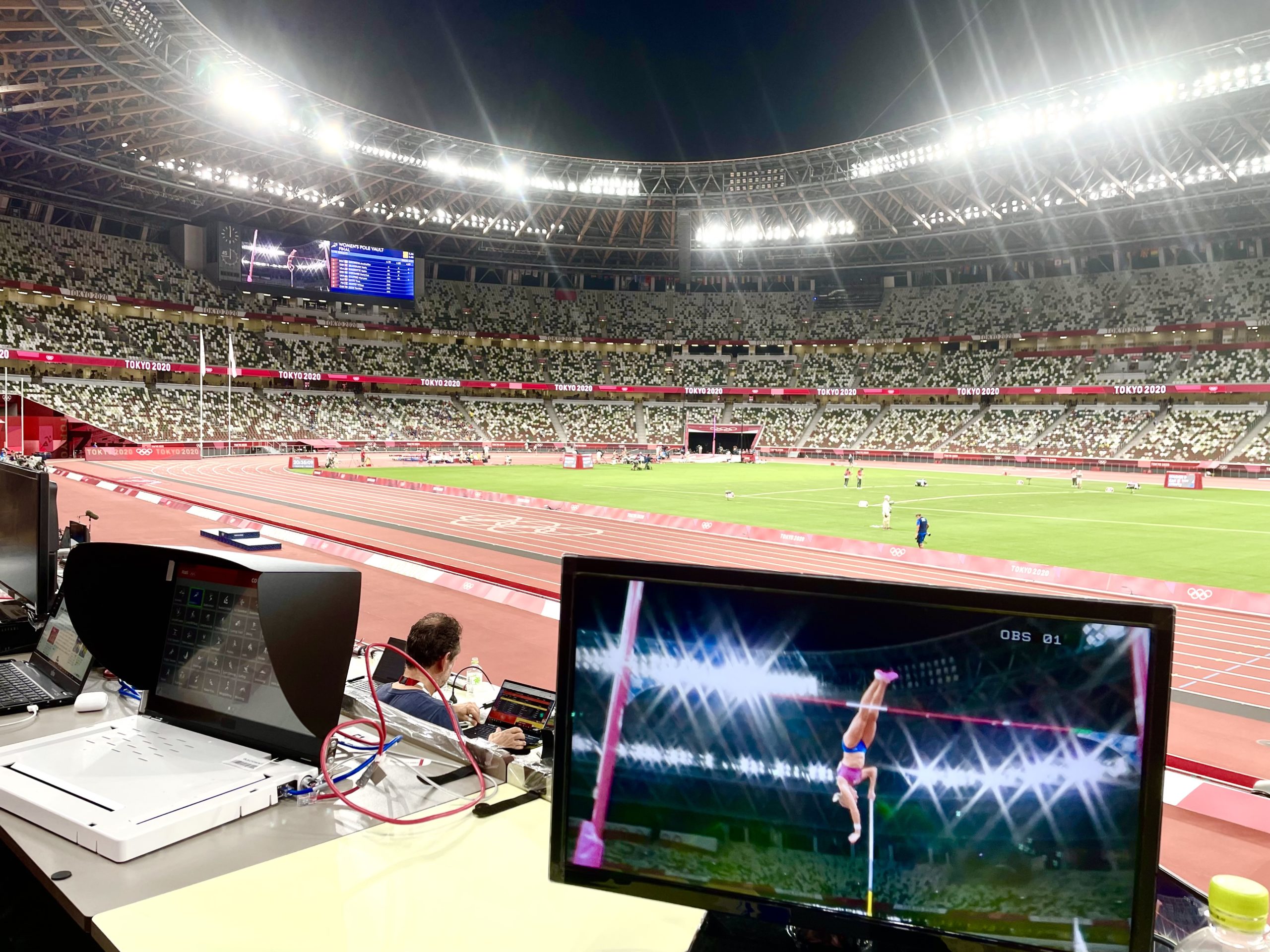
While awaiting Bougard’s final event, the women’s pole vault final got underway in the Olympic Stadium, featuring NYAC medal hopeful, Katie Nageotte. The winner of the Olympic Trials and a seventh place finisher at the 2019 World Championships, Nageotte breezed into this final looking every bit like a medalist.
But she didn’t make it easy on herself. At her opening height of 4.50m/14’ 9” she made two ragged attempts before sailing clear on her third. By way of context, she cleared 4.90m/16’ 0 3/4” in Monaco a few weeks ago. Nageotte also missed her first attempt at 4.70m/15’ 5”, a height at which, ultimately, only she and three others went clear, among them the defending champion, Katerina Stefanidi from Greece. Looking best of all was Anzhelika Sidorova from the Russian Olympic Committee, who had cleared both heights thus far at her first attempt. Filling out the front foursome was Great Britain’s Holly Bradshaw.
So, the bar went to 4.80m/15’ 9”. Sidorova sailed over, as did Nageotte. Stefanidi needed two attempts, as did Bradshaw. Up we went, to 4.85m/15’ 11”. Stefanidi missed her first. Sidorova had air to spare, clearing it with no evident problem. Bradshaw also effected a flawless clearance, as did Nageotte. Interesting. Tense. Stefandi missed twice, then passed, and the bar went to 4.90m/16’ 0 3/4”. At which stage Sidorova had her first miss of the competition. Bradshaw also missed her first. So did Nageotte. Stefanidi, having failed twice at 4.80m, had one shot to clear this height. She failed, meaning that the medalists had been decided. All that remained was to decide who got what.
Sidorova missed her second go at 4.90m. So did Bradshaw. If Nageotte cleared, she would secure an enormous advantage in the game of vertical chess. Which she did, with air to spare. The NYAC woman almost sailed over the stadium roof. If there had been a crowd, the roar would have been deafening. A beautiful clearance saw a gold medal within her grasp. The pressure was on Sidorova and Bradshaw, meaning majorly.
Bradshaw missed. It was between Sidorova and Nageotte for the gold medal. The tension on Sidorova’s face was plain. She attacked the bar, but was never close. A third miss. The gold medal belonged to Nageotte. It was a thrilling competition, not to mention nerve wracking. For me, I mean. I think Katie was fine. Sidorova shed tears of frustration. Nageotte shed tears of joy. You could almost forget that the stadium was 90% empty, which speaks volumes for the athletes and for the beauty of world class athletic competition. In my humble opinion, that is.
But this NYAC day was not over. Still to come was Erica Bougard in the final event of the heptathlon, the 800m. Truth be told, Bougard knew at this stage that she was out of contention, and her 800m performance reflected that. At the line a time of 2:15.92 brought her 880 points, bringing her final tally to 6379 and her final placing to ninth.
But if you consider the results of this one day at the Olympic Games – gold, silver, fourth, ninth, and a team of nine qualifying for a final – you would have to deduce that this was a pretty good day for a pretty good club. And still there is more to come.